One Farmer Started Feeding the Soil. Now the Whole County Is Paying Attention.
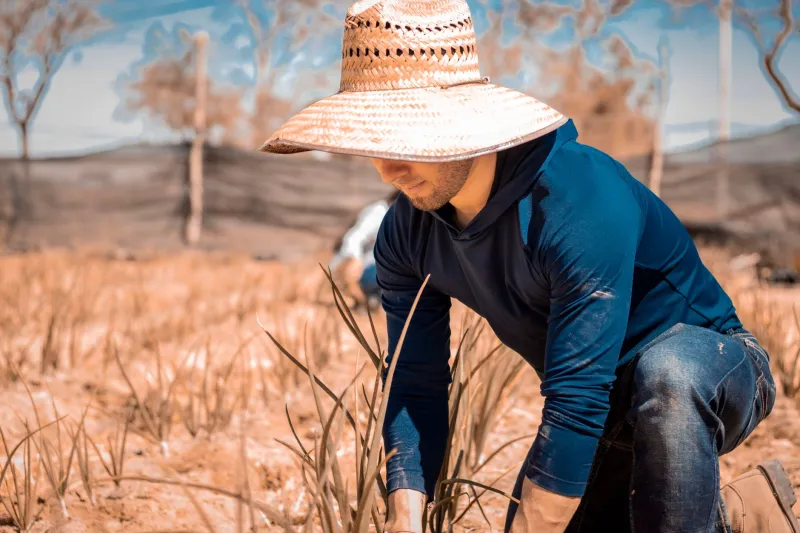
There's a particular kind of quiet that settles over a healthy field. Not the eerie silence of exhausted ground — that's a different thing entirely — but a living stillness, full of beetles and earthworms and fungal threads doing invisible, essential work just beneath your boots. Stand in Marcus Bellew's cover-cropped fields outside Salida, Colorado on a cool October morning, and you'll feel exactly that.
Three years ago, this same ground was compacted, pale, and hemorrhaging topsoil every time a hard rain rolled through. Today, it's dark and crumbly and smells faintly of petrichor even when it hasn't rained in a week. The difference, Marcus will tell you with characteristic understatement, is that he finally stopped fighting the land and started working with it.
What he probably won't tell you — because he's not really that kind of guy — is that his quiet experiment in regenerative agriculture has set off a chain reaction that's reshaping how an entire region grows its food.
From Skeptic to Believer
Marcus didn't come to regenerative farming through an online course or an idealistic dream. He came to it through desperation. After a brutal 2020 drought season followed by an unusually wet spring that washed away a significant portion of his topsoil, he sat down with his accountant and had the kind of conversation farmers dread. The input costs — synthetic fertilizers, herbicides, diesel for repeated tillage passes — were eating him alive. Something had to change.
A neighbor passed along a dog-eared copy of a soil health guide from the NRCS. He attended a no-till field day over in Pueblo almost as a joke. Then he started talking to Adrienne Solís, a soil health specialist with the local conservation district, who walked his fields with him and described what she saw in language that stuck: "You're spending money trying to replace what the soil used to do for free."
That sentence, Marcus says, rewired something in his brain.
He started small — cover crops on thirty acres, eliminating one tillage pass, reducing his synthetic nitrogen application by a third. The first year was nerve-wracking. Yields dipped slightly on two fields, held steady on the rest. But his input costs dropped noticeably, and a soil test that fall showed measurable improvement in organic matter percentage.
The Numbers That Changed the Conversation
By year two, the story the data was telling became hard to ignore. Organic matter in his test fields had climbed from 1.8% to 2.6% — a significant jump in a short timeframe. Water infiltration rates improved dramatically, meaning less runoff and less irrigation needed during dry stretches. His earthworm counts, a low-tech but telling indicator of soil life, had roughly tripled in the no-till sections.
On the economic side, Marcus had cut his fertilizer spend by nearly 40% across the operation. His cover crop seed costs offset some of that savings, but not all of it. For the first time in several years, his margins actually widened.
He started talking about it. Not loudly — Marcus isn't a loudly kind of person — but at the grain elevator, at the diner in town, at the annual conservation district meeting where he'd normally just sat in the back row. People listened, because farmers always listen when someone's numbers are genuinely better.
"I wasn't trying to convince anybody of anything," he says, leaning against his truck in that way that suggests the conversation might go on a while. "I was just answering questions."
A Domino Effect, Field by Field
The questions kept coming. By the end of year two, three neighboring operations had reached out to Adrienne at the conservation district asking about cover crop mixes and no-till equipment. One of them, a fourth-generation wheat and corn operation run by the Ybarra family about eight miles east, enrolled thirty acres in a USDA conservation practice program and began transitioning their most erosion-prone ground.
Then a larger operation to the north — over 1,200 acres — sent two of their field managers to shadow Marcus for a day. They've since eliminated fall tillage on roughly half their acreage.
Adrienne, who has been doing this work for eleven years, says she's never seen uptake like this move so organically through a farming community. "Usually you're pushing information uphill," she explains. "When it starts pulling itself — when farmers are calling you — that's when you know something real is happening."
The regional conservation district has since formalized what Marcus started informally, launching a peer-learning network that now includes fourteen farms across three counties. Monthly calls, occasional field walks, shared data. Low-tech, high-trust.
What It Means for the Food System
The environmental math here matters beyond any one farm's bottom line. Healthier soil holds more carbon. It filters water more effectively, reducing nutrient runoff into the Arkansas River watershed downstream. It builds resilience against the kind of weather volatility that's becoming the new normal across the Southern Rockies.
But there's a food security dimension too. Farms with better soil health are more stable operations. They're less likely to face the kind of financial cliff edge that pushes family farms toward consolidation or sale. More stable farms mean more consistent local food supply — at farmers markets, through CSA programs, to regional grocers and school food service programs that depend on predictable sourcing.
Several of the farms now in Marcus's peer network have added or expanded direct-to-consumer sales in the past two years. The Ybarra operation, for instance, started a small CSA this past season — something they'd talked about for years but never felt financially stable enough to attempt.
The Slow Work of Changing a Culture
None of this happened because of a policy mandate or a marketing campaign. It happened because one farmer did the unglamorous work of changing his practices, tracked his results honestly, and talked about it with his neighbors. That's how farming communities have always evolved — not through top-down directives, but through the slow, trust-based exchange of knowledge between people who share the same soil and the same weather and the same bone-deep understanding of what it costs to get something wrong.
Marcus is already planning his next move: integrating a small beef cattle operation to graze cover crops and cycle nutrients in a way that further reduces his external input dependency. He's reading everything he can get his hands on. He's still answering questions.
Back in that quiet October field, he reaches down and picks up a clod of soil, breaks it apart with his thumb and forefinger. It crumbles cleanly, the way good soil does. A couple of earthworms retreat from the sudden light.
"It took a while," he says, "but the ground's coming back."
So, it seems, is everything around it.