When Good Food Goes Bad Faster: The Surprising Truth About Produce That Actually Rots
Somewhere around day four, Sarah Kowalski noticed something that made her stop and think. The peaches she'd grabbed from a farm stand outside Madison, Wisconsin were already soft, fragrant, and honestly past their prime. Meanwhile, the peaches she'd bought at the same time from her local chain grocery store were sitting on the counter looking practically identical to the day she brought them home — firm, faintly shiny, and almost completely odorless.
She'd been doing an informal side-by-side experiment for about two weeks, tracking a haul of farmers market produce against its supermarket counterparts. Tomatoes, lettuce, cucumbers, peaches, and a bundle of fresh herbs. Same general varieties, same storage conditions, wildly different timelines. By day ten, the farmers market tomatoes were a memory. The grocery store tomatoes were still holding their shape.
"I'd always just assumed I was bad at storing food," she said. "Turns out the food itself is the variable."
She's onto something most of us have never been told directly.
What "Shelf Life" Actually Measures
When we talk about produce lasting a long time, we tend to treat it as a feature — a sign of quality, or at least convenience. But shelf life in industrial agriculture is less a reflection of inherent food quality and more the result of a deliberate set of interventions designed to survive a very long, very complicated supply chain.
Here's what that chain often looks like for a conventionally grown tomato: picked underripe in Florida or California, sorted and packed, loaded onto a refrigerated truck, shipped potentially thousands of miles, warehoused, redistributed to regional distribution centers, shipped again to individual stores, and finally set out in the produce aisle — sometimes two to three weeks after harvest. For that tomato to still look sellable at the end of that journey, it essentially has to be engineered to endure it.
That engineering happens at multiple levels. Selective breeding over decades has prioritized firm flesh, thick skins, and the ability to ripen slowly and uniformly after harvest — traits that help the tomato survive logistics, not traits that make it taste better. Many conventional fruits and vegetables are also harvested before natural ripening has completed, because a fully ripe piece of fruit is fragile. It won't make the trip.
Then there are the postharvest treatments. Apples are routinely coated with food-grade waxes to seal in moisture and create that familiar glossy appearance. Some citrus gets treated with fungicides. Certain vegetables are gassed with chemicals to slow respiration and delay decay. Cold chain management — keeping produce at precise, very low temperatures throughout the entire distribution process — further slows the biological clock.
None of these things are necessarily secret. Most are legally permitted and considered safe. But they do raise a question worth sitting with: when the decay clock is that aggressively paused, what else gets paused along with it?
The Biology of Ripening and What It Has to Do With Nutrition
Fruit and vegetables don't just sit still after harvest. They're still biologically active, still converting starches to sugars, still producing the aromatic compounds that make food smell and taste the way it should. That process — ripening — is also when a lot of nutritional development reaches its peak.
Research has consistently shown that the nutrient content of fresh produce begins declining after harvest, and that the rate of decline is tied to how that produce was grown, handled, and stored. A tomato that was picked ripe from a local farm and sold within 48 hours is a fundamentally different nutritional object than one that was picked green three weeks ago and artificially ripened in transit with ethylene gas.
The same goes for leafy greens. Spinach can lose a significant portion of its folate within days of harvest under normal conditions. That farmers market bunch that wilted by Wednesday? It was actively alive in a way that made it both more nutritious and, yes, more perishable.
There's a certain irony in the fact that the most fragile produce is often the most vital.
What the Farmers Market Haul Revealed
Back in Madison, Sarah's experiment got increasingly interesting as the days went on. The farmers market herbs — a bundle of basil and some fresh thyme — were essentially gone by day five, turning dark and losing their fragrance. The supermarket equivalents, packaged in plastic clamshells, looked nearly the same on day twelve as day one.
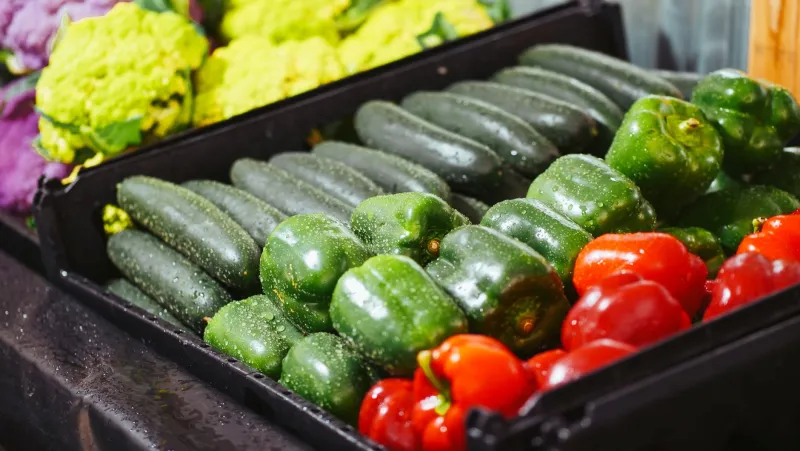
Her cucumber from the farm stand went soft and slightly wrinkled within a week. The store cucumber, coated in a thin layer of food-grade wax she hadn't noticed until she looked closely, was still firm and smooth at the two-week mark.
The lettuce was the most dramatic. Farmers market head lettuce, unwashed and loosely wrapped, started wilting by day three. The bagged supermarket mix — washed, dried, sealed in a modified atmosphere package designed to slow oxidation — was technically still "good" at day fourteen, though the flavor had become noticeably flat.
"By the end I kind of stopped thinking of the grocery store stuff as fresher," Sarah said. "It was more like it had been put on pause."
Rethinking What "Fresh" Even Means
This is where the conversation gets genuinely interesting for anyone who cares about eating well. The word "fresh" in American food marketing has been so thoroughly stretched that it's nearly meaningless. A tomato that was picked a month ago and treated to look presentable isn't fresh in any meaningful sense — it's preserved. The fact that it hasn't visibly rotted is evidence of intervention, not quality.
The farmers market peach that turned soft and sweet by day four? That was ripening happening the way it's supposed to. That fragrance Sarah noticed — the one the grocery store peaches never quite developed — is the result of volatile aromatic compounds that are produced during natural ripening on or close to the tree. Those compounds are also part of what makes fruit nutritionally complex. You can't have one without the other.
Fast spoilage isn't a flaw in local, naturally grown produce. It's a signal. It means the food was alive in the right ways, picked at the right time, and hasn't been chemically intervened with to fake longevity it doesn't naturally have.
The Practical Upside of Perishable Food
None of this means you should feel bad about having to toss that basil. But it does suggest a shift in how we might think about buying and cooking from local sources.
Farmers market shopping rewards a different kind of planning — buying what you'll actually use in the next few days, cooking with what's freshest first, treating produce as the living thing it actually is rather than a pantry staple with an indefinite runway. It's a more engaged relationship with food, and honestly, most people who make the shift find they waste less overall because they're paying closer attention.
It also changes what you're tasting. When Sarah finally bit into one of those farmers market peaches at peak ripeness on day three, she described it as almost embarrassingly good. "The grocery store ones never got there," she said. "They just kind of softened without ever really becoming what they were supposed to be."
That gap — between produce that reaches its potential and produce that merely survives its journey — is the real story behind shelf life. And once you've tasted the difference, a two-week tomato starts looking a lot less like a convenience and a lot more like a compromise.